Betting basics — the price is a percentage, and the stake decides how long you last
Three things, and they are the same arithmetic. A decimal price converts to a chance with one division. A bet is worth taking when your own estimate beats that chance. And the size of the stake, not the quality of Saturday, decides whether the account is still there next month. Paste VIP4YOU at registration. First deposit can be matched 130%, up to $130. That is a ceiling.
Code VIP4YOU — the code we publish, free at registration
Direct answer
Every price on the board is a percentage wearing a disguise.
Divide one by the decimal price and you have the chance it implies: 2.50 is 40%, 1.40 is 71.4%, 1.15 is 87%. A bet is worth taking when your own honest estimate is higher than that number, and worth skipping when it is lower — however the fixture feels. Then decide the stake: one to two per cent of a bankroll you have set aside, the same amount every time. Bonus money is a separate pile with its own target; on the international offer that is bets adding up to five times the bonus, on three or more matches at 1.40 or higher, inside 30 days.
Reading the price
A decimal price is what one unit returns in total, stake included. Back something at 2.50 with $10 and a win returns $25, of which $15 is profit. The same number read as a chance is one divided by the price. Fractional and American notations say the same thing in different clothes.
| Decimal | Implied chance | Fractional | American | Note |
|---|---|---|---|---|
| 1.15 | 87% | 3/20 | −667 | Short. Below the 1.40 floor the international offer sets. |
| 1.40 | 71.4% | 2/5 | −250 | The floor named in the international offer’s own terms. |
| 1.50 | 66.7% | 1/2 | −200 | Clears that floor. |
| 2.00 | 50% | 1/1 | +100 | Even money. The figure India’s own terms name. |
| 2.50 | 40% | 3/2 | +150 | Four in ten, by the price. |
| 5.00 | 20% | 4/1 | +400 | One in five, by the price. |
Convert any price yourself with the odds converter. The one number worth memorising is 2.00, which is exactly even money and exactly 50%.
Why the percentages add up to more than a hundred
Convert every outcome of a market and add them. Two sides priced 1.95 and 1.95 imply 51.3% each, which totals 102.6%. That 2.6% above one hundred is the operator’s cut on that market, and it is why a coin flip is not offered at 2.00 on both sides. The arithmetic above is from the two prices named in it; we have not measured 1xBet’s margin across its board, and no page here prints a figure for it.
Live operator capture
Each number on this board is a chance, not a tip
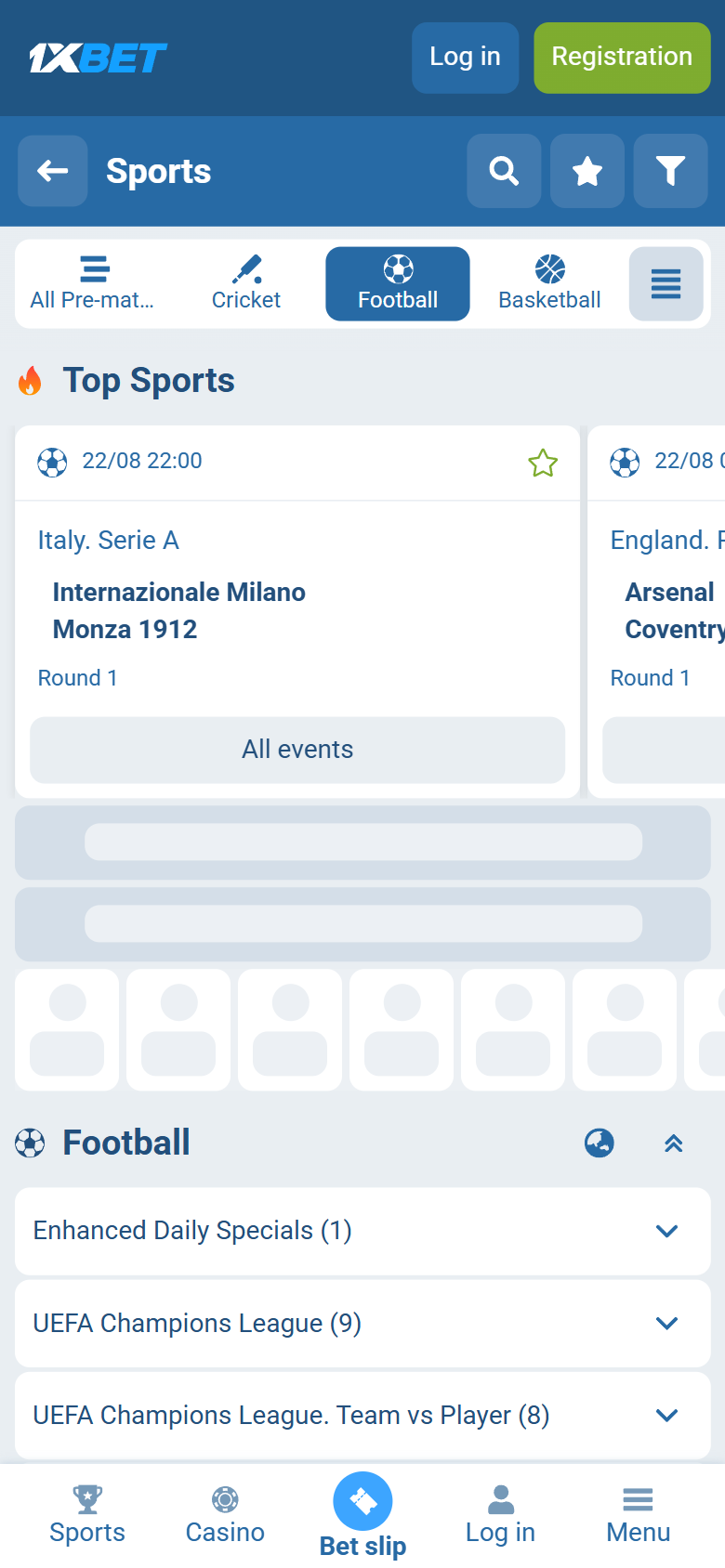
A captured India football board — Serie A, Premier League and Champions League tiles. The three prices on each are home, draw and away. Convert any of them with one division and ask whether your own estimate is higher. The shortest tile is not automatically the best bet, and a long price is not value merely for being long. Fixtures and prices on this board change.
When a price is bigger than the chance
Most people pick who they think will win. That is a different question from whether the price is worth taking. At 2.50 the market is saying 40%. If you rate the same outcome at 50%, the price is generous and the bet is worth making. It can still lose that evening. One result is not evidence about a decision — a good bet loses often, and a bad bet wins often enough to be dangerous.
The trap runs the other way too. A 1.15 favourite that “should win” is the market saying 87%. Rate it at 80% yourself and you are paying over the odds for the comfort. On the international offer 1.15 is also under the 1.40 floor, so a slip built on short favourites can fail the offer and the arithmetic at the same time.
10 markets do not use this rule
The 5× target above is the international offer. Where we have read the operator's own country terms, 10 markets publish something different — and in those markets the tickets described above move nothing:
- India — three winning single bets at 2.00 or higher, each staked at the full bonus and placed one after another. One loss ends the offer. Handicaps and totals are excluded.
- Cameroon, Ghana, Kenya, Nigeria, Senegal and Zambia — the bonus arrives in two halves. One clears on accumulators; the other only counts inside the 1xGames section, at 30 or 35 times. That section is 1xBet's own quick-games area — the terms name titles like PF Dice, Pachinko and PF Roulette in it, some of which are excluded from the count. It is not the third-party crash games most people mean by that phrase: Aviator, JetX and Spaceman sit in the casino and move neither half.
- Tanzania — eight times the bonus, not five, and the qualifying legs start at odds of 2.10 rather than 1.40.
- Jordan and Thailand — we could read the offer but not the multiplier: those terms pages render their own numbers blank until you have an account. Rather than repeat the five-times figure from elsewhere, we say nothing and point you at your own bonus balance.
Ghana, Nigeria and Zambia also step the percentage with the size of the deposit, and their multipliers step with it. Every country page carries its own figures; the country list is the index, and it now says which rows we read off the operator and which still come from partner listings.
One more line from the terms: on Armenia, Bangladesh, India, Pakistan, Sri Lanka and Uganda, handicap and total bets do not count toward the wagering at all — the rules strike them out together with refunded bets. Build those tickets from match winners, double chance or both-teams-to-score there.
How much to stake
Two people can pick winners at the same rate and finish the month in opposite places. The difference is stake size. Staking will not turn a losing method into a living, but bad staking will empty a decent one.
$200 set aside, 2% units
A unit is $4. Ten losing tickets in a row cost $40 and leave $160 — an ugly week with the account intact. Stake $40 a ticket instead and the same ten results end it. Identical picks, opposite endings.
- A dedicated pile. Rent, bills and savings stay out of it. If losing the amount would change a Tuesday, it is not a bankroll.
- Units, not moods. One unit is 1–2% of that pile, and it stays the same after a win and after a loss.
- Do not chase. Doubling the next ticket to win the last one back is how a bad hour becomes a bad month.
- Re-size slowly. Recalculate the unit when the pile has actually moved, not after one Saturday.
- A stop for the session. Decide in advance what a bad day looks like, and close the app when you reach it.
- Bonus money is not this pile. It has its own target and its own clock — see how the bonus balance behaves.
If a losing run is not stopping, or the size of a bet has started to matter, the limits and self-exclusion tools are the page to open, not this one.
Betting basics FAQ
How do I turn decimal odds into a percentage?
Divide one by the price. 2.50 gives 1 ÷ 2.50 = 0.40, so the price implies a 40% chance. 1.40 gives 71.4%. That percentage is what the price is saying, not a promise about the match.
What does value betting actually mean?
You bet when your own estimate of the chance is higher than the chance the price implies. At 2.50 the price implies 40%. If you honestly rate the outcome at 50%, the price is generous. It can still lose that night — a single result says nothing about whether the bet was right.
Why do the percentages on a match add up to more than 100?
Because the book prices in its own cut. Convert every outcome and add them: on a two-way market at 1.95 and 1.95 the implied chances are 51.3% each, which totals 102.6%. The 2.6% above one hundred is the operator’s margin on that market. We have not measured 1xBet’s margin across its board.
How much should I stake per bet?
A common rule is one to two per cent of a bankroll you have set aside. On a $200 bankroll that is $2 to $4 a ticket. Ten losing bets in a row cost $40 and leave you playing; at $40 a ticket the same ten bets end the account. The picks are identical — the stake decides how long you last.
Does the same staking rule apply to bonus money?
No. Bonus money sits on its own balance with its own target and its own clock. On the international offer that is bets adding up to five times the bonus, on three or more matches at 1.40 or higher, inside 30 days of registration. Ten of the sixteen country sites whose terms we have read publish another shape. Work through that on its own terms, then fold whatever converts into the cash pile.
Is a short favourite a safe bet?
A short price is not the same as a safe outcome — it is the market saying the chance is high, and you pay for that in the return. A 1.15 favourite implies 87%. If you only rate it at 80% you are paying over the odds, and on the international offer 1.15 also sits under the 1.40 floor.
Code VIP4YOU — then stake something you can repeat
The code we publish, September 2026. First deposit can be matched 130%, up to $130. That is a ceiling. What the bonus asks for before it becomes cash is on your own country page.
VIP4YOU